










Social media



The growth of indoor mobile usage and the rollout of 5G are creating new challenges for in-building mobile coverage across commercial and public buildings. Depending on the site, several DAS architectures can be considered: passive DAS, hybrid DAS and active DAS.
Each approach offers specific benefits in terms of cost, scalability, monitoring and RF performance.
Choosing the right DAS architecture mainly depends on:
A passive DAS remains widely used for mid-sized projects with controlled radio requirements. Hybrid and active DAS architectures provide greater flexibility for more complex or fast-evolving environments.
| Features | Passive DAS | Hybrid DAS | Active DAS (e.g. ZoneDAS Two) |
| Cabling | Thick coaxial cable (7/8" or 1/2") | Fiber or Ethernet cable with PoE to the remote unit, then coaxial to the antennas | Optical fiber or Ethernet cable with PoE (CAT6a/CAT7) |
| Signal attenuation | High, especially over long distances, splitters and 5G frequencies | High only on the final coaxial section | Very low thanks to optical or analog transport |
| Management and monitoring | Very limited supervision | Partial monitoring up to the remote unit | Proactive supervision via Web GUI, SNMP and VLAN |
| 5G n78/n77 compatibility | Possible depending on architecture and distances | Dependent on RF losses on the coaxial section | Optimized for 5G NR bands up to 300 MHz bandwidth |
| Scalability | Constrained modifications requiring RF balance maintenance | Flexible on the main network, more limited on the antenna side | Modular architecture with simplified addition of bands or remote units |
| Multi-operator | Possible | Possible | Native via Neutral Host architecture |
| MIMO support | Limited depending on passive architecture | Possible by multiplying coaxial architecture | 4x4 MIMO compatible |
| Typical use cases | Offices, hotels, small public buildings | Mid-size sites and large buildings | Stadiums, hubs, campuses, large complexes |
| Power consumption | Low – significant losses depending on coaxial link distance | High – due to high-power radios and coaxial network | Low – low power Active DAS |
Passive DAS remains particularly suitable for small buildings where RF distances are manageable. Its ease of deployment and cost-effectiveness make it an efficient solution for many indoor projects requiring a small number of antennas.
Hybrid DAS architectures offer greater flexibility for larger sites while retaining part of the passive infrastructure, but require a high-power active DAS, which is becoming less and less relevant.
In environments with high user density or requiring significant scalability, Active DAS facilitates the management of radio performance, multi-carrier support, and 5G upgrades; certain equipment, such as Zyxel, also helps reduce costs and is becoming relevant in smaller infrastructures.
Zyxel ZoneDAS Two belongs to the new generation of low-power active DAS solutions. Its analogue architecture supports mobile technologies from 2G to 5G on a single infrastructure.
The solution includes:
Support for signals from low-power small cells also helps simplify certain indoor architectures while keeping infrastructure costs down; the extremely low latency of ZoneDAS solutions even allows them to be powered by donor antennas and repeaters, which further simplifies and reduces installation costs.
There is no one-size-fits-all architecture for indoor mobile coverage. The right choice depends on technical constraints, user density and long-term network evolution goals.
Passive DAS, hybrid DAS
and active DAS each address different use cases. The key is to select the solution that delivers the expected performance today while preparing for the future of indoor mobile networks.
Telenco supports customers in analysing their in-building mobile coverage needs in order to identify the most suitable DAS solution for the site, usage requirements and deployment constraints. Whether the best fit is a passive, hybrid
or active DAS architecture, the goal is to define the most effective technical answer for long-term performance.

Zyxel ZoneDAS Two simplifies the deployment of high-performance indoor 5G mobile coverage. Its fibre-based ActiveDAS architecture is scalable, multi-operator ready and suited to offices, hospitals, industrial sites and transport infrastructure.
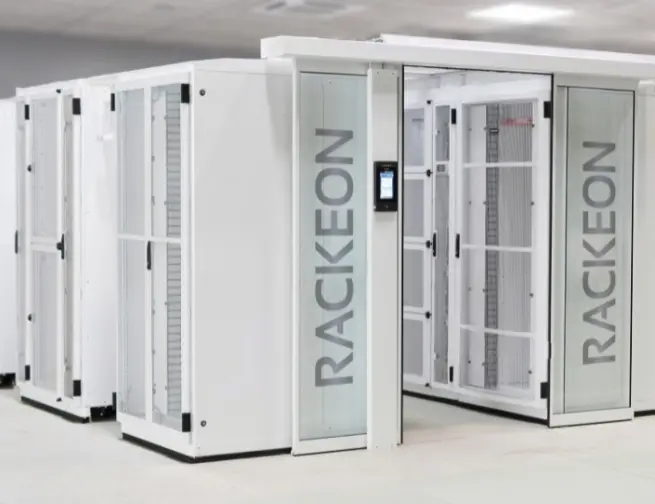
With RACKEON®, Telenco brings its designer-manufacturer expertise to data centre infrastructure. The brand offers racks, cooling systems, aisle containment and intelligent PDUs for digital environments.

Discover how a private 5G network improves coverage, mobility, security and service continuity across industrial, logistics and energy sites, and when to choose it or combine it with Wi-Fi.

NGIS, a Telenco Group subsidiary, has obtained VCA** certification, strengthening its HSE organisation and ability to manage complex wireless and telecom projects.
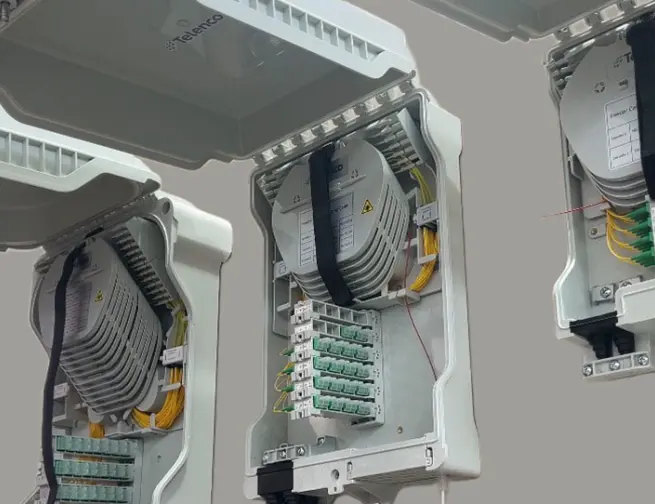
The WGP FL series (BEP) is a modular fibre optic building entry point in 5 versions, from 6 to 144 fibres. NE3/NE4 cable entry modules, splice cassettes, a generous slack storage area and IP55 protection simplify network deployment.

Compare passive, active and hybrid DAS architectures to design reliable indoor 5G coverage for your building, operators and future network needs.
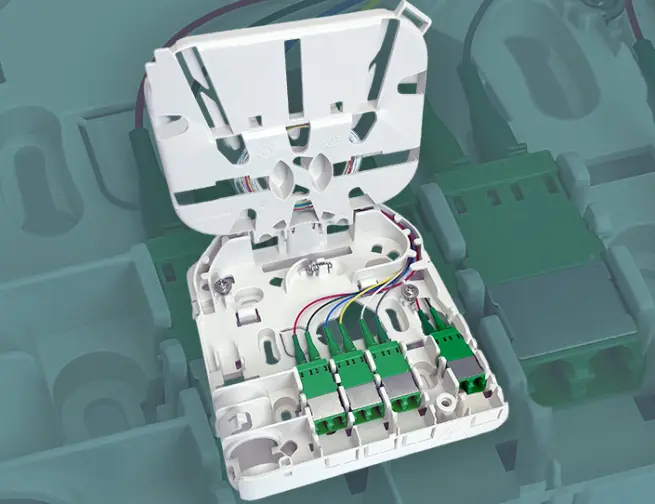
The BEP-XS is an all-in-one solution that simplifies fibre deployments. It combines BEP, floor box and OTO functions, with wall, flush or DIN rail mounting. Ideal for residential projects and network extensions.

Offices, factories, hospitals… mobile signal drops where it's needed most. Modern insulating materials and higher 5G frequencies make indoor connectivity a major infrastructure challenge. For 13 years, Telenco has been deploying dedicated solutions

Skilled labour shortages and tight deadlines: Telenco addresses German market challenges with the Future Line range. Hestia OTO, floor boxes, WGP BEP XS… a complete portfolio for fast, modular FTTH deployments.
These Telenco passive solutions can be directly leveraged by engineers within their models, in line with real-world field constraints. They ensure seamless continuity between the design and deployment phases, with no gaps between planning and implementation.
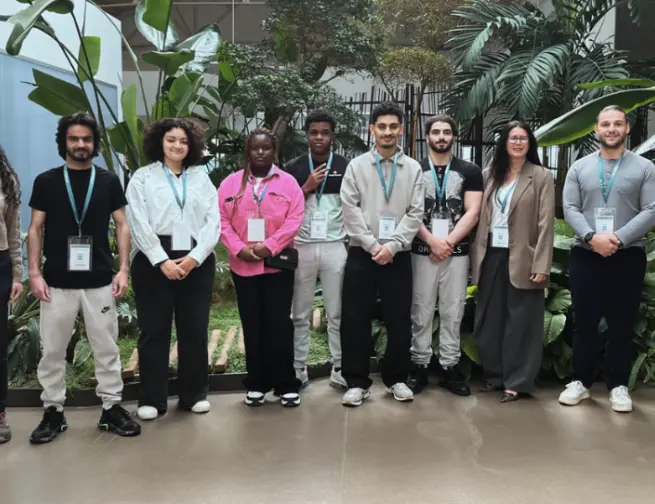
Telenco welcomed six young participants from the Passe Décisive programme for a workplace immersion. The visit combined an overview of company activities with practical discussions on career access and employment.

Through a strategic partnership with Zyxel, Telenco expands its Mobile Networks portfolio with ZoneDAS ActiveDAS solutions. A new approach to deploy high-performance, scalable indoor mobile networks suitable for sites of all sizes.

