










Social media



In a factory, warehouse, or energy facility, a communication network outage can quickly slow down a production line, interrupt data transmission, or bring equipment to a standstill. At the same time, sites are hosting an ever-increasing number of sensors, machines, and connected devices. Their network must therefore remain available, transmit information quickly, and maintain stable performance, even during peak activity periods.
This is where private 5G comes into its own. Deployed across a site or an entire organization, a private 5G mobile network remains under the company's control. This industrial connectivity infrastructure makes it possible to tailor indoor and outdoor coverage, performance, and communication security to real operational requirements, rather than adapting to a generic solution.
In the era of Industry 4.0, equipment no longer operates in isolation. A production line may connect sensors, a supervisory system, analytics tools, and multiple automated machines. If connectivity becomes unstable in one part of the facility, the entire flow of information can be disrupted.
The challenge is similar on a logistics platform, in a port, an airport, or on an energy infrastructure site. These environments are often extensive, combining indoor and outdoor areas, with equipment constantly on the move. In such conditions, inconsistent coverage can delay operations or make critical data unavailable at the wrong moment.
By contrast, a private 5G mobile network is designed around the site's specific requirements. Coverage area, building layout, physical obstacles, device density, and priority applications are all taken into account during network planning. The result is a network engineered for the site, rather than forcing the site to adapt to a generic solution.
On a public network, resources are shared among a large number of users. With private 5G, those resources are dedicated exclusively to the company's operations. This distinction allows businesses to determine which applications should be prioritized and what level of service should be assigned to them.
For example, a remote-control application can be given priority over less critical traffic. Similarly, the network can be configured to maintain the availability of critical equipment, even when site activity reaches peak levels.
Security is just as important. By retaining greater control over data flows, user access, and network architecture, organizations gain additional capabilities to protect their industrial data and strengthen the resilience of their operations. However, the level of security ultimately depends on the network design, its integration with the information system, and the cybersecurity measures implemented.

| Criteria | Industrial Wi-Fi | Private 5G |
|---|---|---|
| Equipment Mobility | Limited suitability for moving assets | Highly suited to continuous mobility |
| Large or Multi-Site Facilities | Requires numerous access points | Coverage designed across the entire site |
| Traffic Prioritisation | Possible depending on configuration | Advanced Quality of Service (QoS) management |
| Latency | Varies depending on the environment | Very low and more predictable, depending on network architecture |
| Centralised Management | Yes | Yes |
Does this mean that Wi-Fi should be replaced? Not necessarily. The two technologies do not always address the same requirements and can coexist effectively. Wi-Fi remains well suited to office environments and many clearly defined spaces. Private 5G becomes particularly valuable when equipment is mobile, sites cover large areas, or service interruptions would have a direct impact on operations.
In industrial environments, Wi-Fi coverage can be challenged by long distances, walls, metal structures, or a high density of connected devices. This does not make the technology unsuitable, but it does require a careful assessment of operational needs before choosing the network architecture.
Private 5G can maintain a consistent level of service across multiple buildings or operational zones. This capability makes it possible to implement a unified network architecture across an entire site, rather than relying on a series of independent local coverage areas. A thorough radio survey is therefore not simply about displaying signal bars. It ensures that teams, machines, and connected devices will benefit from the required service continuity in every critical area of operation.
On the ground, a mobile robot, vehicle, or onboard terminal moves through production areas, loading docks, or storage zones. Private 5G enables seamless handovers between coverage areas without noticeable interruptions. Equipment remains connected and reachable while moving, helping to minimize downtime, maintain operational continuity, and eliminate roaming-related challenges.
It can also support a very large number of simultaneous connections. This capability becomes critical when thousands of sensors, machines, and connected devices need to communicate across the same site.
Machine control, remote operation, and assisted maintenance do not tolerate the same delays as standard office applications. In these situations, every millisecond counts, making connection stability a key requirement.
Thanks to its low latency, Quality of Service (QoS) management, and traffic prioritisation capabilities, private 5G can address these demanding requirements. Data becomes
In a manufacturing plant, a private 5G network can connect production systems, monitoring platforms, sensors, and autonomous vehicles without requiring multiple separate infrastructures. Data is collected continuously throughout operations, giving teams a more accurate view of what is happening across the production lines.
This visibility can help identify performance deviations before they lead to downtime, automate certain repetitive tasks, and enable faster responses when equipment behaves unexpectedly.

In a warehouse or port, operations never truly stop. Goods, vehicles, handheld terminals, and operators move simultaneously across the site. To coordinate these activities, systems must be able to track assets and exchange information in real time, even in the most remote areas of the facility.
The information collected can then feed site management systems, improve goods traceability, and help teams better coordinate the movement of vehicles and equipment.
For energy operators and managers of critical infrastructure, information that is unavailable or delivered too late can hinder facility monitoring and delay interventions. Their network must therefore connect equipment that may be geographically dispersed while maintaining the confidentiality of exchanged data.
A private 5G network can connect these assets, support remote monitoring, and deliver critical information more quickly to field intervention teams.
Private 5G is not limited to industrial environments. Large campuses, research centres, public institutions, hospitals, smart cities, and multi-site enterprises can also benefit from it to connect their buildings, teams, and services. They gain access to a scalable infrastructure that operates independently of public networks and is tailored to their requirements for coverage, security, and data sovereignty.
Private 5G becomes especially relevant when a site combines several of the following characteristics: a large geographical footprint, hard-to-cover areas, numerous mobile assets, applications sensitive to latency, a high volume of connected devices, or stringent requirements for availability, security, and data control.
Beyond improving network performance, private 5G can help reduce operational downtime, improve equipment availability, and support the automation of certain processes. However, the return on investment depends on the selected use cases, the condition of the existing network, the site's operational organisation, and the cost of avoided disruptions. Any assessment should therefore be based on tangible indicators such as equipment downtime, productivity, maintenance efficiency, service quality, or the ability to deploy new applications, while also comparing alternative technologies against business objectives.
A private 5G project does not begin with the selection of an antenna. It starts with a detailed assessment of operational requirements. Which assets need to be connected? In which areas? What level of availability is required? The answers to these questions help define a clear project specification before moving into technical design.
Within the Telenco Group, NGIS through its XG-RAN offering supports organisations. The goal is to deliver a wireless coverage solution tailored to the real-world constraints of each site, rather than applying a standardised configuration.
This expertise is part of the Group’s Mobile Networks offering, designed for telecom operators, industrial organisations.
Private 5G is not necessary for every site. Its value depends on the gap between the capabilities of the existing network and the actual operational requirements. When it addresses a clearly identified need, it can support new use cases and enable long-term site development.
Projects are already being deployed across manufacturing facilities, logistics platforms, and critical infrastructure environments throughout Europe. For every company, public organisation, or operational site, the key question is therefore not whether private 5G is a promising technology, but whether it provides a measurable answer to specific operational challenges. It is this upfront analysis that makes it possible to build a network that is genuinely useful and appropriately sized to meet real requirements.
A private 5G network, sometimes referred to as private 5G, is a mobile network dedicated to the operations of a company, industrial site, or organisation. Its coverage, performance, and security policies are designed and configured according to the specific requirements of the site.
A public network shares its resources among a large number of users. A private mobile network, on the other hand, reserves its capacity for the organisation's operations, providing greater control over access management, Quality of Service (QoS), and data traffic.
Not necessarily. Wi-Fi and private 5G can coexist and complement each other. The most suitable solution depends on factors such as site size, equipment mobility, application criticality, device density, and the required level of service continuity.
The main use cases include manufacturing, logistics, transportation, energy, critical infrastructure, campuses, and certain large commercial, public sector, and institutional sites.
Costs vary depending on the area to be covered, the number of sites involved, the selected network architecture, the devices to be connected, integration requirements, and the expected service levels. A preliminary study is therefore essential to define an appropriate design and budget.
No. It is most relevant when the existing network does not adequately meet requirements for mobility, coverage, availability, connection density, or data control. A detailed assessment of operational needs remains essential before any deployment.
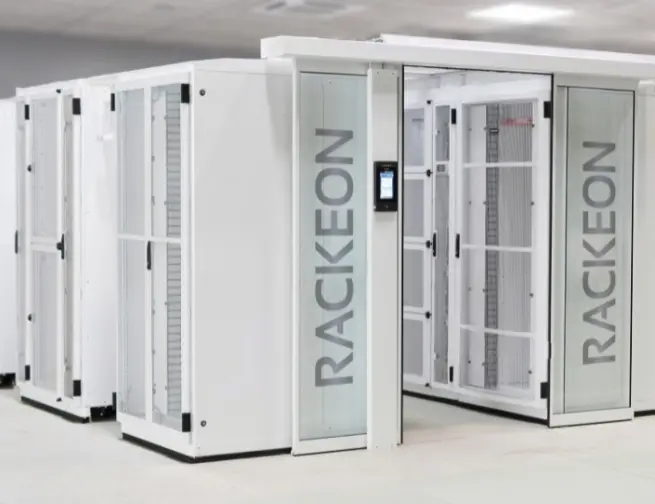
With RACKEON®, Telenco brings its designer-manufacturer expertise to data centre infrastructure. The brand offers racks, cooling systems, aisle containment and intelligent PDUs for digital environments.

Discover how a private 5G network improves coverage, mobility, security and service continuity across industrial, logistics and energy sites, and when to choose it or combine it with Wi-Fi.

NGIS, a Telenco Group subsidiary, has obtained VCA** certification, strengthening its HSE organisation and ability to manage complex wireless and telecom projects.
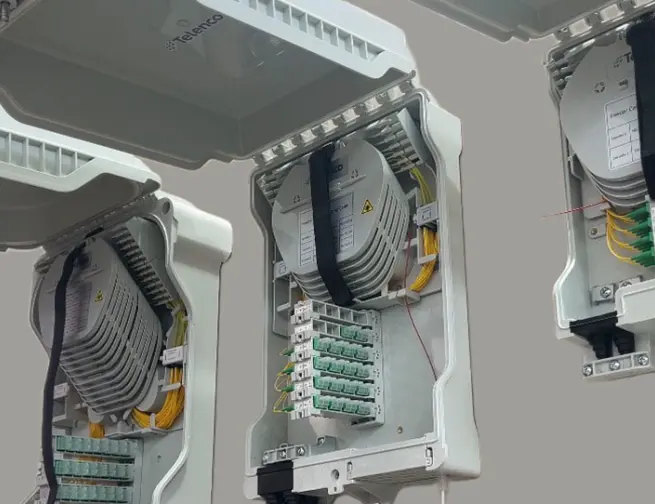
The WGP FL series (BEP) is a modular fibre optic building entry point in 5 versions, from 6 to 144 fibres. NE3/NE4 cable entry modules, splice cassettes, a generous slack storage area and IP55 protection simplify network deployment.

Compare passive, active and hybrid DAS architectures to design reliable indoor 5G coverage for your building, operators and future network needs.
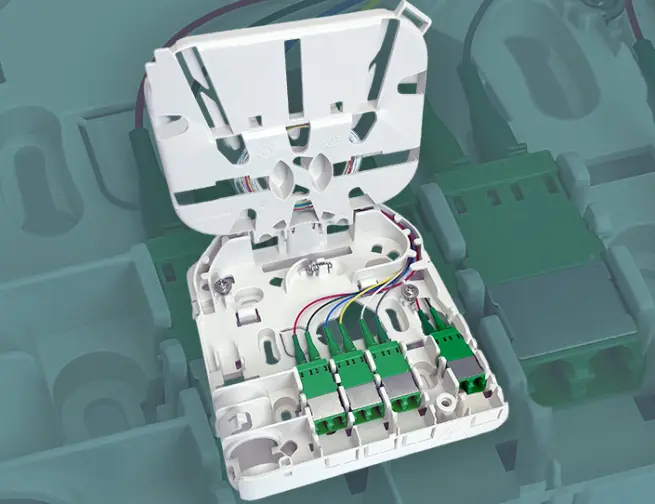
The BEP-XS is an all-in-one solution that simplifies fibre deployments. It combines BEP, floor box and OTO functions, with wall, flush or DIN rail mounting. Ideal for residential projects and network extensions.

Offices, factories, hospitals… mobile signal drops where it's needed most. Modern insulating materials and higher 5G frequencies make indoor connectivity a major infrastructure challenge. For 13 years, Telenco has been deploying dedicated solutions

Skilled labour shortages and tight deadlines: Telenco addresses German market challenges with the Future Line range. Hestia OTO, floor boxes, WGP BEP XS… a complete portfolio for fast, modular FTTH deployments.
These Telenco passive solutions can be directly leveraged by engineers within their models, in line with real-world field constraints. They ensure seamless continuity between the design and deployment phases, with no gaps between planning and implementation.

Telenco welcomed six young participants from the Passe Décisive programme for a workplace immersion. The visit combined an overview of company activities with practical discussions on career access and employment.

Through a strategic partnership with Zyxel, Telenco expands its Mobile Networks portfolio with ZoneDAS ActiveDAS solutions. A new approach to deploy high-performance, scalable indoor mobile networks suitable for sites of all sizes.

Telenco has been awarded a B rating by CDP for its climate transparency in 2025, among nearly 20,000 companies assessed. The recognition highlights the quality of its reporting, risk management and commitment to a low-carbon, sustainable economy.

